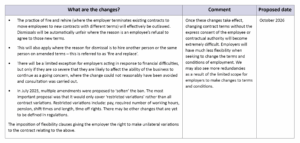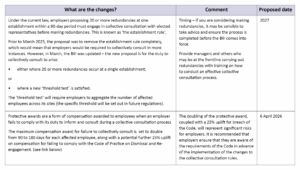


On 10 October 2024, the Labour Government introduced the long-awaited Employment Rights Bill (“the Bill”), described as “the most significant reform of employment law in over 30 years.” You can read our initial overview in Employment Rights Bill 2024: The First Look for Employers.
On 12 March 2025, it completed its third reading, which we reported on here. In July, the government released its implementation plan.
On 28 October, the House of Lords considered amendments and the House of Commons’ reasons for disagreeing with some of the House of Lords’ amendments. Much to the surprise of many, the Bill did not proceed to final agreement on that date as the House of Lords rejected some of the government’s preferred positions and insisted on amendments which the government had previously resisted, such as the abolition of the qualifying service in unfair dismissal claims. On 5 November, the House of Commons again insisted on making protection from unfair dismissal a day-one right.
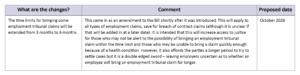
The Government has quietly revealed a major change to Unfair Dismissal in its release of the Unfair Dismissal Factsheet on the Employment Rights Act 2025.
The key take aways are that from 1 January 2027:
The Employment Rights Bill received Royal Assent on 18 December 2025 and became the Employment Rights Act 2025.
The only substantive provision that came into force on that day was the repeal of the provisions introduced by the Strikes (Minimum Service Levels) Act 2023.
Details of the expected consultations and impact assessment for the removal of the unfair dismissal compensation cap will follow.
The Government has now published several ancillary documents related to the trade union changes under the Employment Rights Act 2025 which are due to come into force on 18th February 2026.
Transitional and saving regulations also come into force on the same date. These relate to how the law applies in the period around these specific trade union-related measures coming into force. They address how to deal with certain cases that began under the Trade Union Act 2016 legal framework but are still in progress when the Employment Rights Act 2025 comes into force. Government guidance on these transitional provisions is provided in Trade Union Law: Transition to Employment Rights Act 2025
The landmark Employment Rights Bill has now been passed in the House of Lords and is likely to receive Royal Assent in the coming days, so we may have the new Employment Rights Act 2025 before Christmas.
The only remaining issue was the House of Lords amendment requiring retention of a compensation cap on awards for ordinary unfair dismissal. It seems that following various business groups writing to ministers encouraging that the Bill is passed, combined with the government committing to publish an impact assessment, including an assessment of the removal of the cap, before commencement of regulations, the Lords decided to back down, instead removing the amendment and allowing the Bill to pass. The impact assessment provides some reassurance, but it remains to be seen what the overall impact of these changes will be on claims, the tribunal system, employers and their businesses.
Whilst having the position confirmed may bring some relief amongst employers, there will now follow a lot of change and still much uncertainty. It is anticipated that the unlimited unfair dismissal compensation and six-month qualifying period will apply from 1 January 2027. It will be interesting to see if this results in mass dismissal amongst businesses. Employers may now decide to bring forward restructuring plans and/or look at exiting more highly paid employees who may not be performing sooner, so as to minimise these new risks.
The government has accepted the House of Lords’ demands to have a six-month qualifying period for unfair dismissal, with day one rights being abandoned. This followed a long process of ‘ping-pong’ where the two Houses battled over the length of the qualifying period.
Other issues of contention remain A number of previous Lords amendments have been dropped, and the Bill continues to take shape as it progresses through Parliament but there is now a real chance we may see the Bill become law before Christmas.
The Department for Business & Trade has also announced that the Government has committed that any future changes to the unfair dismissal qualifying period will require primary legislation, and that the compensation cap will be lifted. This is a significant new development, although the detail and timing remain unclear.
The Employment Team at Warners are keeping an eye on further updates and will update this page as we learn more.
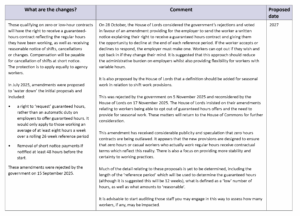
The Bill returned to the House of Lords on 17 November, where the House of Lords again rejected the government’s position on day one unfair dismissal rights and on the guaranteed hours scheme, where the House of Lords continue to insist on the right to ‘opt out’.
The House of Lords accepted the House of Commons rejection of the following amendments previously proposed by the Lords, so these have now been dropped: